
UTQG – Uniform Tire Quality Grading, is a compulsory grading system required for tyre manufactuer to imprint on the tyre sidewall in order to be sold in the U.S. market.
Only passenger tyre is required for UTQG ratings. Others like motorcycle tyres, commercial tyres, and light truck tyres (including 4×4 tyres such All-Terrain tyres, Mud-Terrain tyres) are exempted. As a result, tyres that do not print or had blur ratings will be recalled.
On the flipside, UTQG is not compulsory on other markets like Europe and Asia. Hence, some tyres, as long as it’s not selling in the U.S. market, may not have UTQG rating on it. It’s also possible that the batch of tyres sold in the U.S. market is different from the batch sold in other areas, therefore, it does not have UTQG rating on it even if the same tyre model is sold in the U.S. and your area.
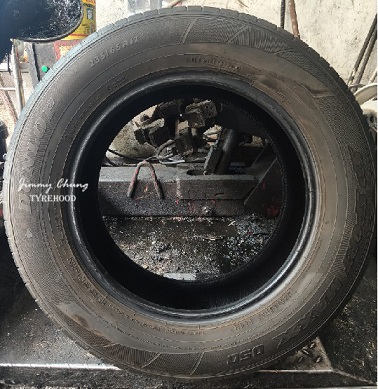
The system has 3 categories: Treadwear, Temperature, and Traction. Every category is self-tested by tyre manufacturer, following the U.S. government standard.
Treadwear
The higher the treadwear value, the more mileage (longer distance) a tyre can last.
The treadwear value is rated against the baseline treadwear 100.
Let’s assume that treadwear 100 can last for 10,000km.
| Treadwear | Distance (km) |
| 100 | 10,000 |
| 150 | 15,000 |
| 200 | 20,000 |
| 300 | 30,000 |
Treadwear 150 can last 1.5x longer.
Treadwear 200 can last 2x longer.
There is no exact distance given for treadwear 100. Various assumption is made and you may treat it as ~ 10,000 miles (~16,093km), and a treadwear 200 last ~ 20,000 miles (~32,186 km).
“The test is performed by running one vehicle fitted with a set of test tires and one vehicle with a set of course monitoring tires in a convoy on a defined public road course in the San Angelo, Texas area.” – from NHTSA
Therefore, how much a tyre mileage can use subject to vehicle type, maintenance, drivers’ habit such as speeding, road conditions and so on. Nevertheless, it’s still a good gauge to estimate the different tyre models mileage.
Traction
It actually refers to wet grip (braking distance) rather than dry traction. It classifies as “AA”, “A”, “B”, and “C”. “AA” rating has the best wet grip whereas “C” has the worst wet grip.
“represent the tire’s ability to stop on wet pavement as measured under
controlled conditions on specified government test surfaces of asphalt and concrete. A tire
marked C may have poor traction performance.”
“The traction grade assigned to this tire is based on braking (straight ahead) traction tests and does not include cornering (turning) traction. ” – from NHTSA
Hence, traction rank “A” can still outperform another with rank “AA” under the same tyre brand in various performance under wet conditions.
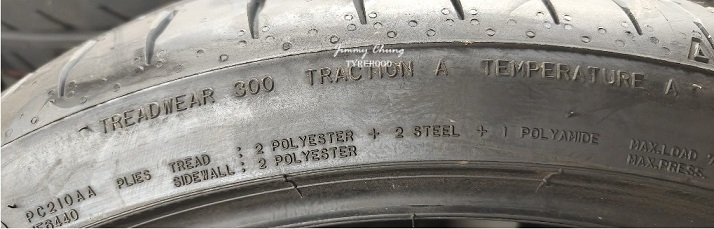
FK520L UTQG: Treadwear 300, Traction A, Temperature A
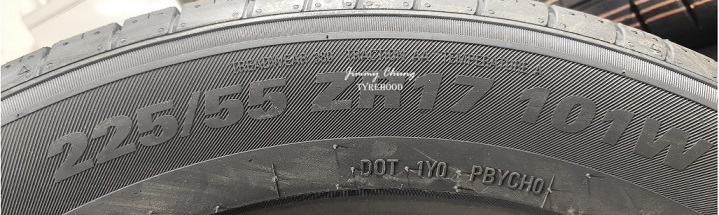
Kumho HS52 UTQG: Treadwear 380, Traction AA, Temperature A
Traction rating is tested in a moving vehicle at 40mph (~ 64km/h) on wet asphalt and wet concrete road, calculating using coefficient of friction. Applied grading only if both side meets the criteria. E.g. AA needs >0.54 and >0.38
| Traction rating | Wet ashpalt coefficient | Wet concrete coefficient |
| AA | >0.54 | >0.38 |
| A | >0.47 | >0.35 |
| B | >0.38 | >0.25 |
| C | less than “B” | less than “B” |
Modern tyres these days normally rank “A” and above. Only a few rank “B”. “C” normally doesn’t come out.
Temperature
Rank “A”, “B” and “C”, with “A” being the best to withstand and dissipate heat.
“Sustained high temperature can cause the material of the tire to degenerate and reduce tire life, and excessive temperature can lead to sudden tire failure.” – NHTSA.
Heat buildup somewhat can help a tyre to stick on the floor better due to the bonding between tyre and the floor. A kind of chemical reaction. And a small amount of heat can facilitate this chemical reaction. Nevertheless, too much of the heat will cause the bond to break, result in tyre traction failure.
To simplify, imagine you get ice cubes from the fridge and you want to melt the ice quickly. You decide to use fire to melt the ice. You want to melt it real quick and make the fire bigger (increase temperature). The ice melt but instead of turning into water, it goes into vapor.
Temperature rating is VERY important to long haul drivers. Higher speed accumulates more heat and heat can built up in long distance. As a result, temperature rating “A” is preferred if you are driving over the speed of 150km/h
Limitation
Almost all non-US consumers may mistake the use of UTQG to cross reference with all different brands and models.
The treadwear result is self-tested by tyre manufacturers. Although the testing is done through the standard given by the U.S. department (just like EU tyre label), there is still possible variation in different testing methods.
As such, Falken FK520L with treadwear 300 does not imply it cannot last longer than Kumho HS52 with treadwear 380.
Nonetheless, UTQG is a VERY good indication to compare the same brand and models.
If Falken FK520L compares with its own brand e.g. ZE310 R with treadwear 320, it indeed implies ZE310 R can last longer than FK520L. (by 6.7% comparing to FK520L milage)
| Treadwear | Distance it can last | |
| 100 | (assume) 10,000 miles (~16,093km) | |
| FK520L | 300 | 30,000 miles (~48,279km) |
| ZE310 R | 320 | 32,000 miles (~51,497km) |
The difference between FK520L and ZE310 R does not match with the 6.7% as the distance is referenced to the control baseline treadwear 100.
To purchase automotive tire, batteries and automobile, travel and personal insurance in HK, whatsapp Jimmy +852 5113 0668
Other related article:
-> How to read EU Tyre Label
-> How to decode Thailand Eco Tyre Label
Other article:
-> Tyre related information
-> Vehicle maintenance and DIY
-> Global Travel Guide
