

How well do you know electricity? Voltage vs current? Not many of us studied physics and chemistry. A number of us, even including highly educated person sometimes are being deluded by some uneducated salesperson.
In this article, learn about what the text and values imprinted on the label of the battery. This helps you understand better about battery. You may probably know more than the person who sell you the product.
Voltage (V)
It is the electric potential differences between two points in a circuit. Simply, it is the pressure that pushes current through a circuit.
Ampere (A)
It is the unit used to measure electric current.
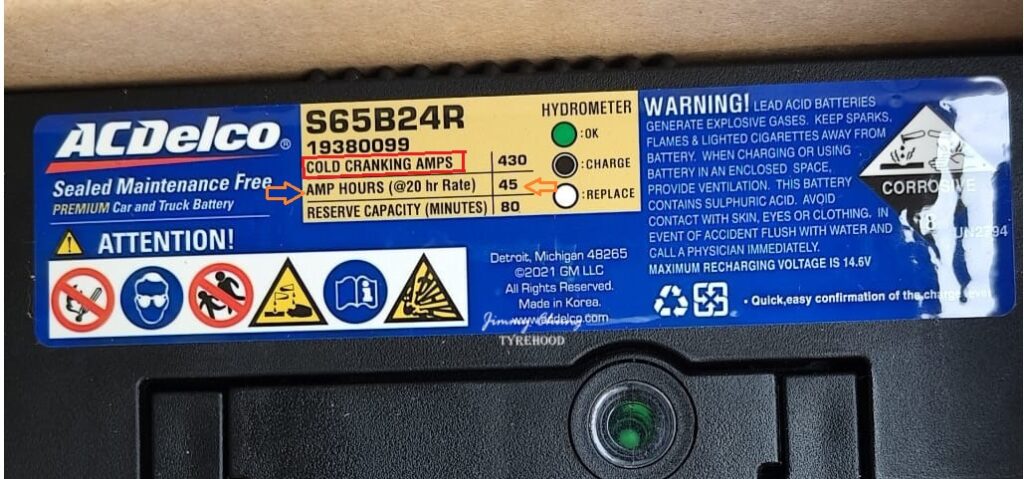
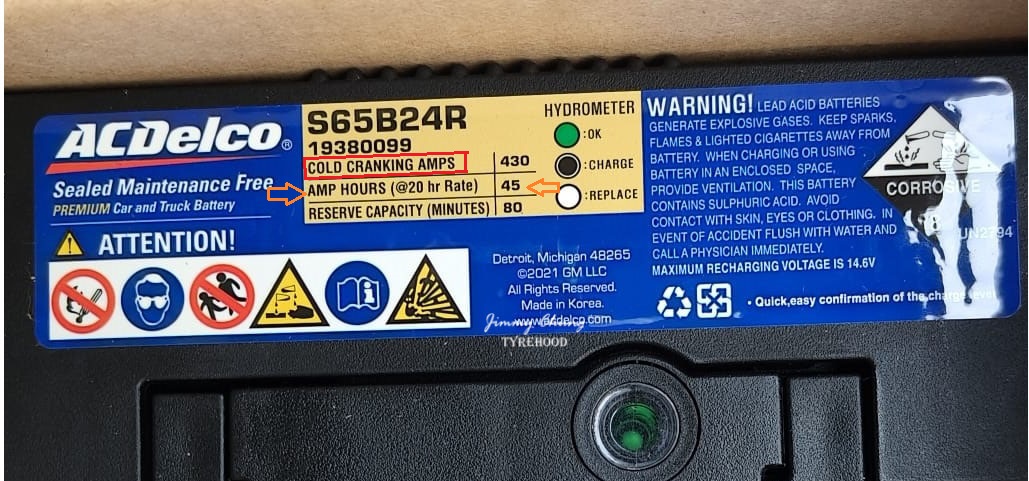
Cold Cranking AMPS (CCA)
Some battery imprinted the text as CCA. As the name states, it’s the ampere value that the battery can give under cold weather at -18 degree C.
Some battery shows CCA value like : 830 A (EN/SAE/GS). It implies the battery also went through these testing standards. However, it does not mean it also have 830 CCA rating under EN/SAE/GS standard.
Following further explanation of these standards:
EN – European Norm
CCA is tested under European Norm standard also at -18 degree C. The EN standard testing is stricter than the normal CCA, hence, battery that shows 830 CCA, normally have lower value like 770 – 800 CCA depending on the battery model. Different battery model have different result, thus there aren’t any accurate specific value to deduct and convert the CCA to EN CCA.
SAE – Society of Automotive Engineers, USA
CCA tested under this standard is more lenient than EN standard. SAE CCA value normally higher than the specified CCA (e.g. CCA: 800, SAE CCA >800).
There might be other text on the battery as follow:
GB – Guobuiao standards, National standards of China
MCA – Marine Cranking Amps, measured at 0 degree C
CA – Cranking Amps, measured at 0 degree C. Not commonly seen in international market.
Should you care?
VERY Important to those who stayed in the North and South of the world like Canada, U.S. Australia, Northen China (normally Northern Guangzhou and above) and Japan.
It’s not as important in hot climate regions like Singapore, Hong Kong and Taiwan. The lowest temperature you probably experience is around 0 degree C during winter in Hong Kong on a mountain.
However, you can use it to refer how well/fast it can crank your vehicle. Besides, diesel vehicle uses more CCA than petrol vehicle. Diesel vehicle should not use CCA that is much lower than original equipped even in hot climate regions. (slightly lower is fine)
Amp Hours (Ah)
It implies the maximum ampere it can release per hour (normally under 20 hours) to support the vehicle when the car alternator is down. In this case, 45Ah means the battery can release 2.25A per hour in 20 hours until 10.5V. It’s also important to take note that this value only applies if the battery is full level.
Furthermore, it can still continue releasing current below 10.5V. But things start to get unstable.
A lot of people in Hong Kong mistaken Ah value with battery capacity. Lots of them believe that the higher the Ah value, the higher the battery capacity such that they can use the battery longer. Ah value indirectly shows the capacity but it doesn’t mean it can offer higher battery capacity to be used longer. In fact, battery capacity isn’t a public data from the manufacturer. It also cannot be calculated using Ah and CCA value.
Should you care?
Very important to those who will drive a long journey. My friend in Australia needs to drive from her house to workplace (town area) for around 1.5 hours. If her car alternator breaks down half way, higher Ah value can further support her to drive all the way to the town area for repair.
Small places like Hong Kong, it’s very easy to get to the nearest garage. Worst case, it’s also very easy to get a tow.
RC – Reserved Capacity
A period where the battery can discharge 25A for the specified minutes when the battery is fully charged. It’s not the period that can allow you to drive until the battery is depleted.
E.g.
RC = 80 implies the battery can discharge 25A for 80 minutes.
RC = 160 implies the battery can discharge 25A for 160 minutes.
Should you care?
The same as Ah value. Nobody knows when exactly the alternator will break down. However, it can be assumed around as early as 150,000 km to 230,000 km (or might be longer). Under this situation, you may want to calculate if the RC can support you to the nearest garage.
FAQ
1. Does above apply to hybrid vehicle and electric vehicle?
A: Yes. But it doesn’t take a lot CCA to crank a hybrid and electric vehicle. RC does not apply to EV as EV uses lithium battery for power rather than alternator. If the lithium battery is down, you can’t even drive further.
2. Is higher the Ah value better?
A: Depends. If you have a higher Ah value, you need more time to recharge the battery. Vehicle owner shouldn’t opt for higher Ah value if the vehicle is not frequently used, especially weekend drivers.
Never use higher Ah value to determine battery longer usage period. Most Hong Kong drivers are misled by this information.
3. What is DIN?
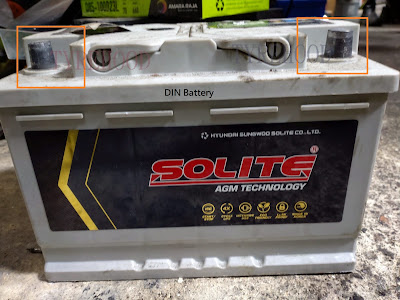
DIN stands for Deutsches Institut für Normung. It’s a German standard (in the past) for automotive battery installation. This standard feature the battery with terminal head cave in, unlike JIS standard with terminal head protrudes out.
These days, vehicle with 12V battery located inside the vehicle cabin will use DIN standard battery such as BMW and Toyota Sienta. More vehicles such as Nissan started using DIN standard battery.
4. What is JIS?
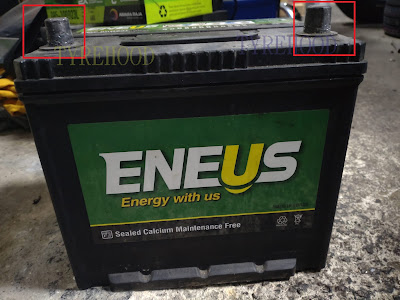
JIS stands for Japanese Industrial Standard. It features with terminal head protrudes out. With the rise of Electric Vehicles, more brands (except Tesla) are using DIN standard.
5. Can a vehicle swap from using JIS standard to DIN standard or vice versa?
Practically speaking, Yes for JIS to DIN if the terminal head can be fixed. Most vehicle battery terminal equipped with BMS (Battery Management System). It may not fit into the battery terminal.
Additionally, it’s strongly not advised to change from DIN to JIS. JIS battery with protrudes out terminal may easily touch nearby parts, causing short-circuit.
6. Do you need to register the battery after replacment?
There’re lots of advise from people that you need to register the battery to the ECU after replacement. Practically speaking, No to most brands even for BMW, Mercedes Benz, Toyota, and so on.
One day, I installed a Varta E39 AGM on a mini cooper and asked the driver to come back on the next day for checking. I made a OBD diagnosis and found that the new battery is automatically registered on the ECU.
The BMS is not stupid. It can even detect if the battery has been replaced simply taking out the terminal. Only if you are changing from a EFB to AGM then you will need to register the battery again.
Conclusion
The value on the label is important, only if you know the meaning of it. Not just because the value is higher, it’s better. In case of alternator breaks down (battery icon signal* lights up on the dashboard), remember to switch off all electrical appliances such as air-con, plug out all USB and drive to the safest place or nearby garage.
*A LOT OF Hong Kong drivers mistaken the battery icon on the dashboard refers to 12V battery issue.
AXA Travel, Home, Accidential Insurance offer promotion periodically as well as Zurich general insurance.
To purchase automotive tire, batteries and automobile, travel and personal insurance in HK, whatsapp Jimmy +852 5113 0668
Other related articles:
-> Recommended battery brands in the year 2026
Other articles:
-> Tyre related information
-> Automotive Battery related information
-> Vehicle maintenance and DIY
-> Global Travel Guide
