
Tyre leaks – It happens to all drivers. Those without Tyre Pressure Monitoring System (TPMS) on their vehicles, over 70% of the drivers realize tyre leaks too late that the tyre is damaged beyond repair.
To enhance vehicle safety, the U.S. was the first to legalize TPMS to be equipped on the vehicle in 2005, then followed by the E.U, Japan, South Korea, China and some other. Places that are not mandated by the law, TPMS normally is not included except European made vehicles like Benz and BMW.
I am supposed to convince you to get a set of DIRECT TPMS. But before going into detail, we first need to know the two types of original equipped TPMS in the automobile market. If you do not have any TPMS on your vehicle, you can click here to direct you to the beneficial of direct TPMS.
TWO TYPES OF TYRE PRESSURE MONITORING SYSTEM (TPMS)
Indirect and direct. Both systems assist drivers to inform tyre leaks and meet the law requirement in some countries. However, indirect TPMS comes with several weakness that drivers fail to notice.
Indirect TPMS
Indirect TPMS does not have any sensor inside the wheel. It leverages on ABS sensor to detect the tyre circumferences. If one of them has tyre leak, circumferences of the tyre changes as compared to opposite tyre, triggering TPMS light on.
Indirect TPMS has one major flaw. If both tyres leak , lets say both drop to 26psi, low pressure light may not get triggered. Furthermore, some vehicle may not trigger the low pressure light even both tyre pressures have 10 psi differences or more. Without knowing the pressure value of a tyre, a driver hardly know what happens in each tyre.
Indirect TPMS met the legal requirement in some countries, providing almost no cost for vehicle owner to maintain.
Direct TPMS
A sensor is installed with tyre nozzle in each rim to detect the tyre pressure value directly. Tyre pressure is shown on the dashboard but not on the older generation vehicle.
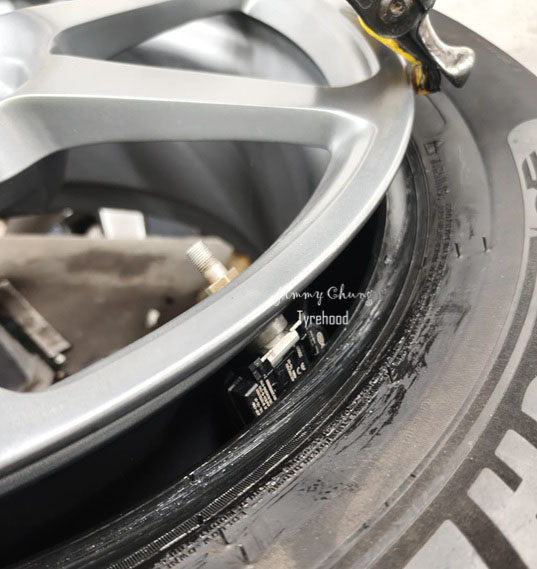
Direct TPMS normally is an option payment on European made vehicles in places like Hong Kong, making it a lot more expensive to purchase as original equipment.
Vehicles with direct TPMS have a minimum tyre pressure value set in the ECU. For instance, Tesla minimum tyre pressure is 38psi. There are two types of direct TPMS available – Bluetooth TPMS, original equipped in Tesla (for year 2021 and thereafter), and Wifi TPMS, mostly used in other vehicle brands like Toyota, Ford, BMW and more.
| Bluetooth TPMS | Wifi TPMS | |
| Means of data transfer | Bluetooth | Wifi 315Mhz / 433 Mhz |
| Accuracy | Depending on the sensor chips. Most of the time 0.5 – 1 psi buffer | Depending on the sensor chips. Most of the time 0.5 – 1 psi buffer |
| Lifespan | Shorter | Normally longer |
| Reflect change of psi | Much Faster | Takes a little more time |
| Sensor Replacement | Depending on vehicle models. Brands like Tesla only require change of sensor. New sensor will automatically match with the ECU. | All vehicle models require sensor programming and/or ECU programming. |
Beneficial of Direct TPMS
Direct TPMS isn’t just about showing pressure value of the tyre. If you know how to exploit it, it is the greatest weapon in the world that assists your driving and maintains your tyre in good condition. It can shrink the tyre market size, hence no technicians willing to take the initiative to tell you the benefits of TPMS.
Over the years, vehicles equipped with direct TPMS are more likely “save” their punctured tyres beyond repair. Following examples of tyre leak beyond repair. These vehicles do not have direct TPMS installed on the vehicle.
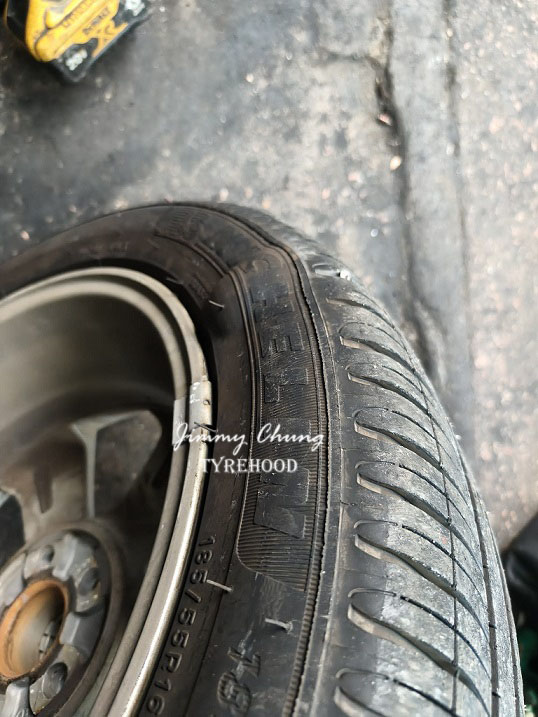
Tyre sidewall bulb (bulge) arises as tyre goes too low pressure. The sidewall goes flat and the nail at the tread area puncture at the sidewall.
It can still be patched if the driver monitored the tyre pressure
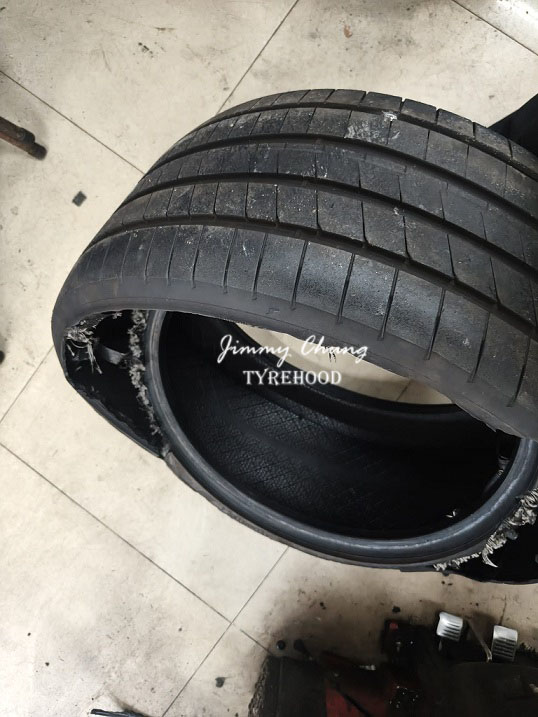
Tyre side wall torn apart as tyre keeps running under very low or 0 psi pressure.
Pros of direct TPMS:
- Properly maintain tyre psi to avoid uneven tyre wear off
- Save fuel/electric efficient (seriously)
- Realize tyre leak even before indirect TPMS alert
- Save tyre beyond repair
- Avoid major tyre breaks down
I will break down each pros how to exploit using direct TPMS in the another article.
What if you have indirect TPMS or no TPMS on your vehicle?
You can purchase external / add-on Tyre Pressure Monitoring Sensors for your vehicle.
The whole package comes with 4 sensors to install on the rim with a small monitor showing the pressure and temperature of the tyres.
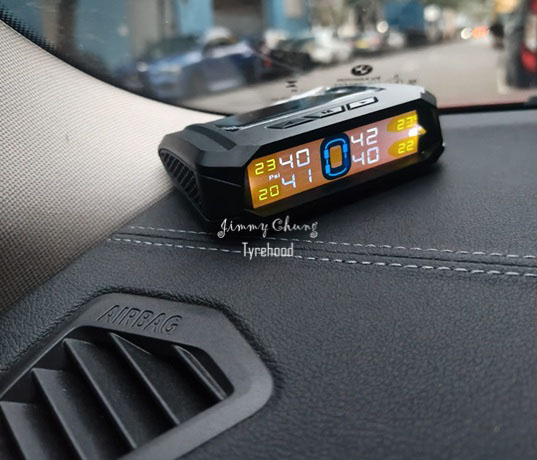
Two types of external TPMS available in Tyrehood.
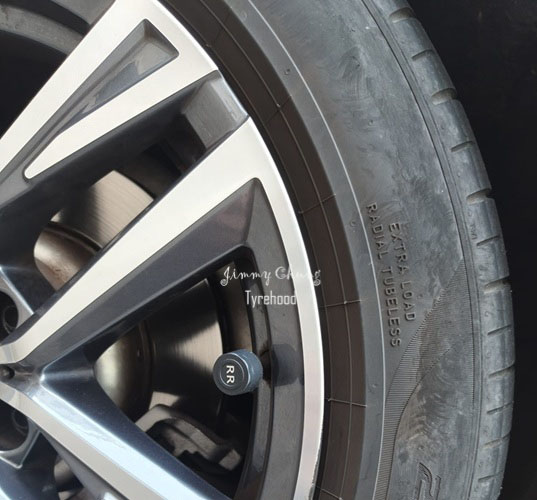
The external cap TPMS is the easiest to use.
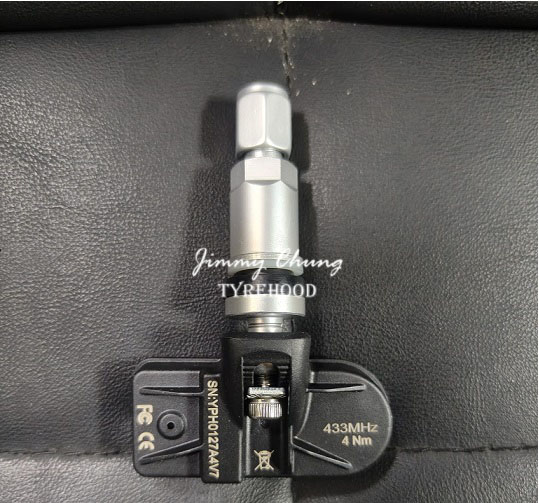
The external direct TPMS can last around 3 – 5 years. This TPMS can be installed at any position. It can detect its position automatically on the monitor.
AXA Travel, Home, Accidential Insurance offer promotion periodically as well as Zurich general insurance.
To purchase automotive tire, batteries and automobile, travel and personal insurance in HK, whatsapp Jimmy +852 5113 0668
Other related articles:
-> Diagnosing Tyre Pressure Warning Light – Not necessarily the sensor issue
-> Tesla TPMS light on but no leak on all 4 tyres? Check this diagnosis out
-> Learn how to DIY replace cabin filter
Other articles:
-> Tyre related information
-> Automotive Battery related information
-> Vehicle maintenance and DIY
-> Global Travel Guide
