
What is EU Tyre labels
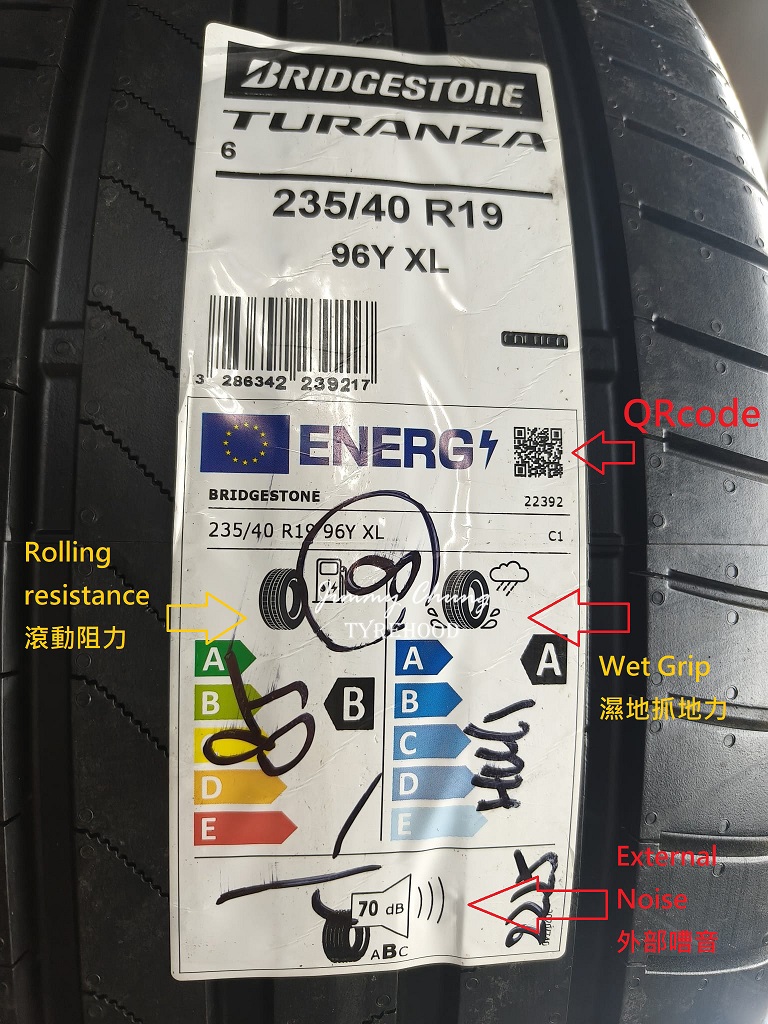
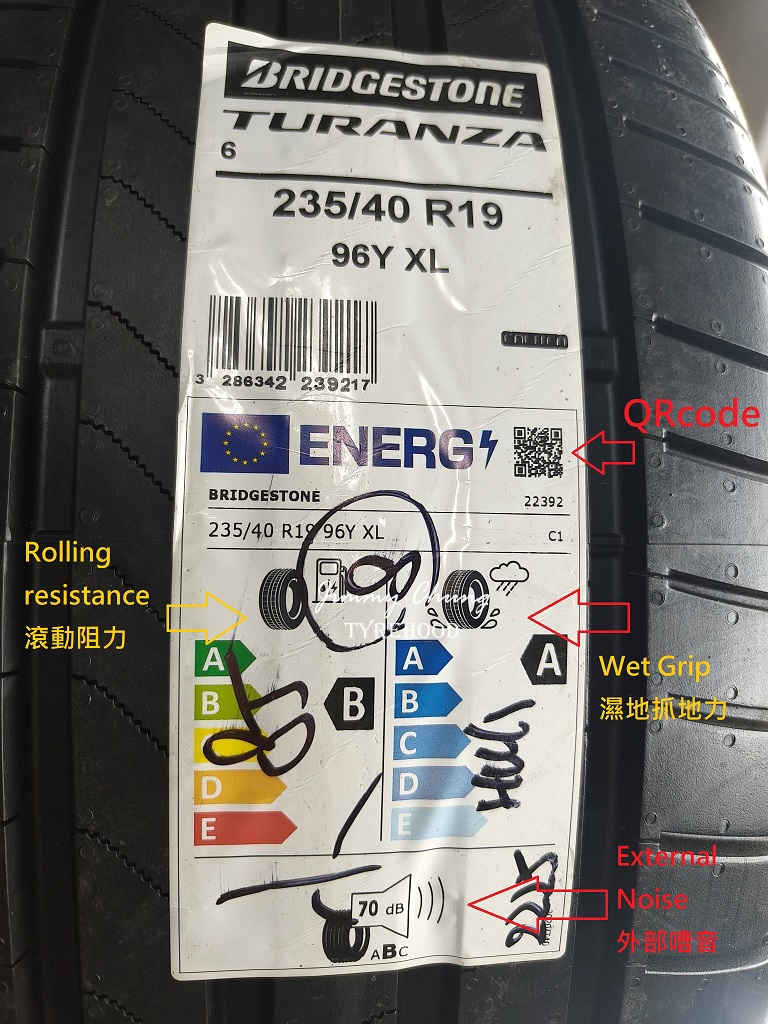
EU tyre label first started on 1st Nov, 2012 under Regulation (EU) 2020/740, covers tyres for passenger cars, light trucks, and heavy-duty vehicles. The data provided aims to help consumers to understand more about the tire performance so that consumers can purchase tires that meet their requirements.
Since 1st May, 2021, a new EU tyre label rules is implemented. One of the most important feature is a QR code included for consumers to browse more data. This prevents counterfeit EU Tyre label stick on the tyre.
EU Tyre Look And Data Explained (in simple terms)
⛽Petrol icon – rolling resistance
The lower the resistance, the lesser fuel(or electricity) a car consumes.
Grading scale: A (best) to E (worst)
Swapping a tire that is A grade to E grade, fuel consumption increased by around 7.5%. Carbon dioxide (CO2) produced increases.
Below is a table about the rough difference between each grade. Each difference can be affected by other factors such as vehicle weight, driver driving habit, road conditions and so on.
| Grade Difference | Fuel Use (in Litre per 100km driven) | % increase |
| A to B | Around 0.1 L | Around 1% |
| B to C | Around 0.1 L ~ 0.15 L | Around 1.5% |
| C to D | Around 0.15 L | Around 2% |
| D to E | Around 0.15 L ~ 0.2 L | Around 2 – 2.5% |
🌧️Rain icon – Wet grip
It measures how well a tyre stops on wet road (braking distance). Higher wet grip grade, shorter braking distance (safer).
Grading scale: A (shortest braking distance), E (longest braking distance)
Each grade difference can mean 3-6 meters longer braking distance (test from 80km/h)
From A to E, difference can exceed 18 meters (about length of 4 cars)
Below is a table about the rough difference between each grade. Each difference can be affected by other factors such as vehicle weight, driver driving habit, road conditions, tire tread condition, tire pressure and so on.
| Grade Difference | Extra Braking Distance (meter) | % increase |
| A to B | +3 – 4m | Around 5% |
| B to C | +3 – 4m | Around 6 – 7% |
| C to D | +4 – 5 m | Around 8 – 9% |
| D to E | +5 – 6 m | Around 10 – 12% |
Based on standardized braking tests from 80km/h on wet asphalt and under test conditions.
“A” rated wet grip tire braking distance takes around 28m – 30m.
“C” rated wet grip tire braking distance may take around 34 – 38m.
*Note that result may still be different due to other factors
External Noise – in dB unit
Grading scale: 1 wave : A rank (quietest) , 2 waves : B rank (medium), 3 waves: C rank (loudest)
Same model with difference sizes can have different external noise.

(Label referred from EU commission)
Snow icon (middle) showing it is a snow tyre.
FAQ
1. Is EU Tyre label compulsory in different regions?
A: No. Tyres sold in Europe, include England, strictly follow the legal rules implemented and therefore, those tyres require to stick with EU tyre label. However, there are different standards implement to be sold in different regions. For example, Thailand and South Korea have their own legal standards for compulsory tyre label.
Japan and China have voluntary tyre label standard to show their tyres performance to consumers.
Places such as Hong Kong which do not have a legal standard for tyre performance may not show EU tyre label on the tyres. Nonetheless, most tyres stick with the EU tyre label to show consumers that their tyres are up to standard for performance.
U.S. uses another standard called U.T.Q.G. , that all tires are required to follow its standard and imprint the results on the tyre such that these tyres can be sold in the U.S. market.
2. How to identify counterfeit EU tyre label?
A: Unscrupulous seller trying to use fake EU tyre label to misinform consumers related to the tyres they purchased. One easy way to check is scanning the QR code of the EU tyre label to cross reference with the product specification. If QR code is missing in the EU tyre label, it is highly likely a fake label.
Some cases of fake EU tyre label can be found online, posted by tyre retail stores. Their images resolution is high enough for me to scan the QR code and check the EU tyre label data. Found out that the EU tyre label info is totally different from the tyre specification label.
3. How does EU tyre label data obtained?
Manufacturers are required strictly to do a standardized track test defined by EU regulations. Authorities will conduct controls to verify accuracy of the declared performance levels.
4. Is EU tyre label data accurately apply to other regions?
No. The result data comes from the standardized asphalt test tracks that built for specific EU reference standards. Road materials are different across different regions such as Asia and U.S. due to seasonal differences, temperature differences, humidity etc.
Hence, “A” rated result not necessarily got the same “A” result if environment changes. Nevertheless, it is still a good reference to find out the tyre performance.
5. Is it possible that a wet grip rated “B” tyre overall performance better than a “A” rated?
Yes. EU Tyre label is done in a controlled test. Not all vehicles in the market are used for testing.
The EU Tyre label does not include other aspects of performance such as cornering, handling, aquaplaning etc. Real world performance may differ due to road materials, climate, and driving conditions.
6. Does a tyre (same size, same model) have different EU tyre label data?
Yes. Two of the same size and model tyre could have different EU tyre label due to different specification such as speed and loading index, original equipped marking (e.g. *, MO, AO), the letter “Z” in front of R and manufacturing places. For instance (below), Bridgestone Potenza Sport 235/35 ZR19 (91Y) vs 235/35 R19 91Y, a missing bracket could have two different data.
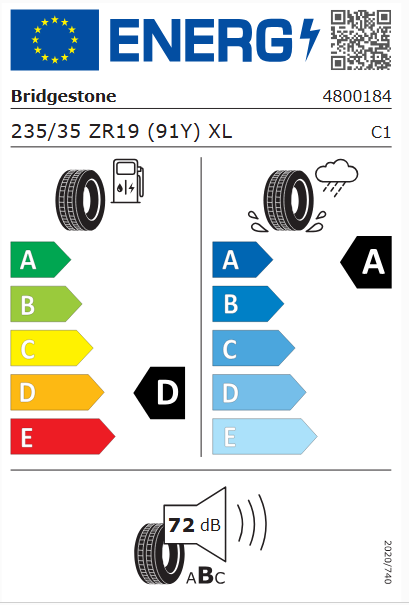
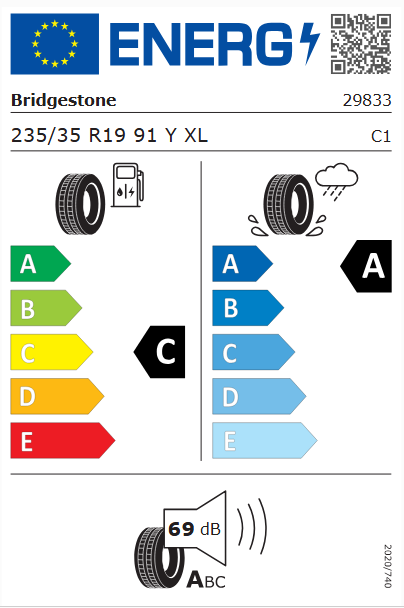
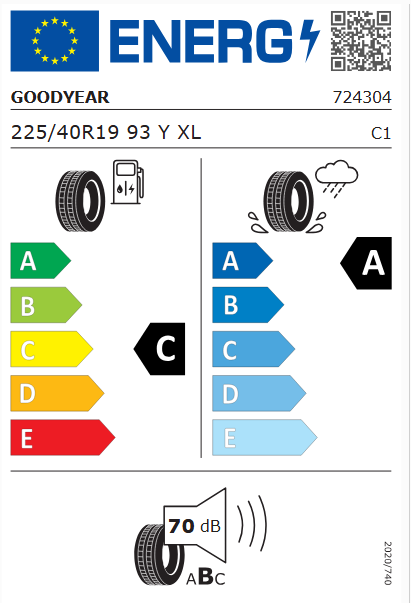
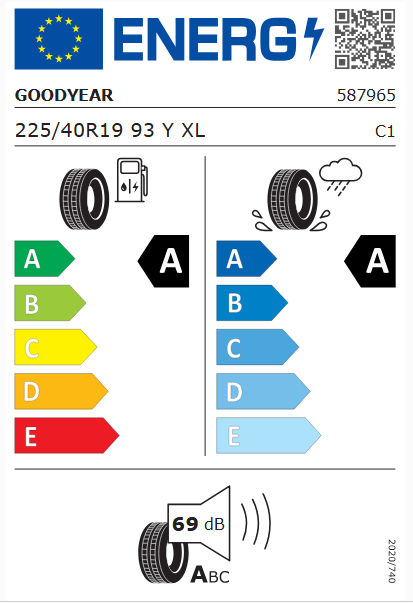
EU tyre label does not specify manufacturing place. Hence, non-EU consumers may not be accurately rely on the EU tyre label. Another example will be Good year F1A6 225/40 R19 93Y as depicted below. Both label shows exactly the same specification but different grading. Non-EU consumers will need other regions tire label for further reference.
To purchase automotive tire, batteries and automobile, travel and personal insurance in HK, whatsapp Jimmy +852 5113 0668
Tyrehood website will keep updating tire models specifications and tire label data from different regions such that you can refer from the data and found out more about the tire performance.
