
Run-flat tyres became widely known ever since more new vehicles are excluding the spare tyres 10 years ago (or maybe longer). Some customers can decide whether they want to get run flat tyres or tyre sealant when they first purchased the vehicle.
Does it worth? Is it suitable for your requirement? Understand more about run-flat tyres before replacing a set of brand new tyres. You may possibly need these tyres in your journey.
What is run-flat tyre?
According to tyre manufacturer, run-flat tyre keeps supporting the vehicle under 0 air pressure for around 80km (50 miles). Run flat tyre is manufactured with reinforced sidewall (very hard sidewall) so that it can support the vehicle under 0 pressure.
Pros
- drive up to (around) 80km under 0 pressure
- due to harder material, it’s supposed more difficult to get punctured compared to normal tyre
Cons
- Hard sidewall makes the vehicle jumpy while driving
- Commonly noisier than normal tyre
- Some ultra high performance tyre model does not have run flat model options
- run flat option performance can be different from the normal tyre option
To clarify a possibility of getting tyre puncture more than twice for the same tyre, driving under 0psi for 80km is an accumulated distance.
Possibility of puncture through the sidewall
Reinforced sidewall does not mean it won’t get punctured at the sidewall. Run-flat tyre in Chinese language is being named as “防爆” (translate to English means – prevent burst), causing misunderstanding in a lot of drivers. Almost all of the customers I came across states that: “I thought it’s “防爆”. It’s supposed not getting punctured / burst right?”
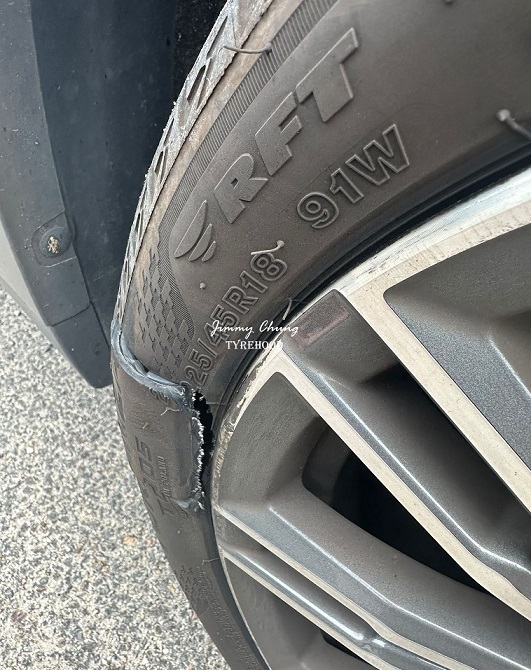
One of my Tyrehood customer with a set of run-flat tyres had its sidewall burst suddenly when he drove across a metal linkage.
Installing run-flat tyre is recommended if:
- your driving road has a high possibility of tyre puncture
- on a long journey, you do not know how to patch your tyre / do not know how to install spare tyre / you do not have a spare tyre with you
- your journey nearby does not have any garage, tyre retail store that can assist you
- it is difficult to call for emergency tow in your journey
- And maybe more….
If you decide to get a set of run flat tyres, you need to meet the following requirements stated from tyre manufacturers:
1. Vehicles with TPMS system (Tyre Pressure Monitoring Sensor System)
Because of the strong sidewall, most drivers are unable to feel/notice the run-flat tyre is punctured. Therefore, TPMS is required to inform drivers about air leak.
All European made vehicles are manufactured with indirect TPMS system or direct TPMS system to warn drivers about tyre pressure loss. However, there were rare cases where the indirect TPMS system was not functioning, resulting in run-flat tyres torn apart.
Some Japan/China brands do not come with TPMS system in some regions. Hence, drivers are required to get add-on TPMS (regardless of external/internal TPMS) to assist in your journey.
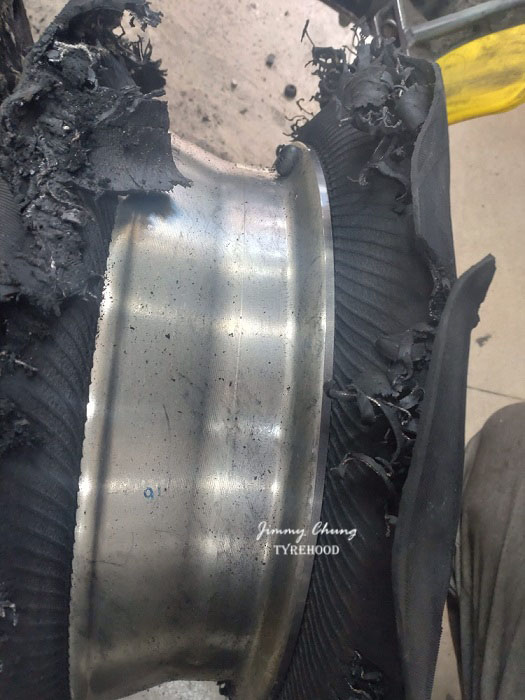
The image below is an example of a driver fails to notice the run-flat tyre is punctured and continue driving for a long miles, resulting in tyres torn apart, leaving the sidewall intact with the rim.
2. Tyre rim with two wheel humps
The second requirement from tyre manufacturers is the specification (inner design) of tyre rim.
All tyre wheel design to have at least one hump to hold the tyre tightly such that the tyre will not come off if tyre goes through cornering, and especially if the tyre leaks to 0psi. The hump looks exact like the image below, red rectangle on top.
Tyre manufacturer requires the rim to have two of it (two humps on both side) in order to utilize the function of run-flat tyre, preventing two side of the tyre comes off the rim.
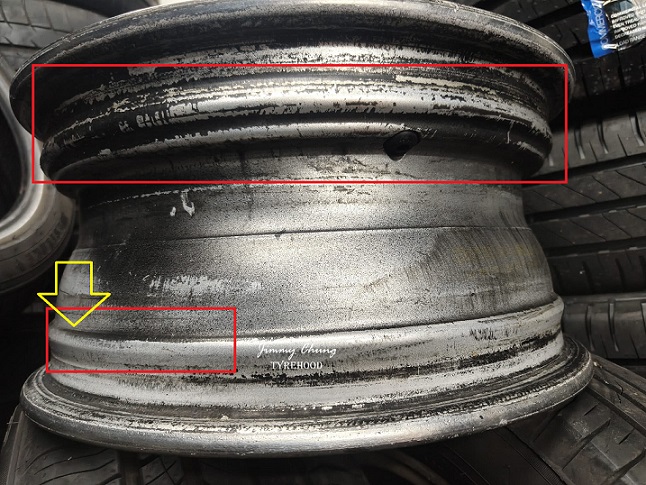
The bottom rectangle (yellow arrow pointing at it) is also called a hump. However, it isn’t the same as the top one. It create similar effect as the top one, but under stronger force will still make the tyre come out on that side. (Afterall, it is easier to dismount the tyre from there)
This rim is also not as recommended to install run-flat tyre.
Original equipped rim and/or after market may only have one hump such as Tesla Model 3 / Y rim. It’s difficult to check on the outside whether the rim has one or two humps. Some rims do not even show the specification properly at the back. You will need to dismount the tyre to check it properly.
If you are planning to get run-flat tyres, and planning to purchase after market rim, make sure you get two humps after-market rim.
Alternative Run-Flat Tire Knowledge
Michelin actually has a special Pilot Primacy G3 tire made specifically for armored luxury cars, which also features run-flat capability. However, this tire cannot be found in ordinary tire shops.
FAQ
1. Does run-flat tyre suitable for Electric Vehicle?
A: Yes, as long as you can tolerate the cons of the run-flat tyre. Otherwise, there are other options to choose such as getting self-seal tyre but its tyre puncture protection is not as good as run-flat tyre. Another option will be installing tyres like Pirelli Pzero E, a EV tyre specifcally designed for Electric Vehicle with run-flat abilities. But its run-flat distance is only up to around 40km.
2. Is run-flat tyre more expensive than normal tyres?
A: Yes. Depending on the regions you are, places like Hong Kong, some models are just a little more expensive. Around HKD100/tyre more expensive than normal tyre.
3. Does run-flat tyre have different performance than normal tyres?
A: Yes. It depends on the model that you choose from. For instance, Bridgestone T005 run flat vs Bridgestone S001 run flat. The latter offers more grip than T005. It’s like choosing premium comfort tyre vs high performance tyre.
4. How to distinguish run flat tyres from normal tyres?
A: Following is the text imprinted on the tyre sidewall with different brands naming it.
| Bridgestone | RFT (Run-Flat Technology) / Driveguard |
| Michelin | ZP (Zero Pressure) |
| Continental | SSR (self-supporting run-flat) |
| Pirelli | Run Flat |
| Goodyear | ROF (Run-on-Flat) |
| Dunlop | DSST (Dunlop Self-Supporting Technology) |
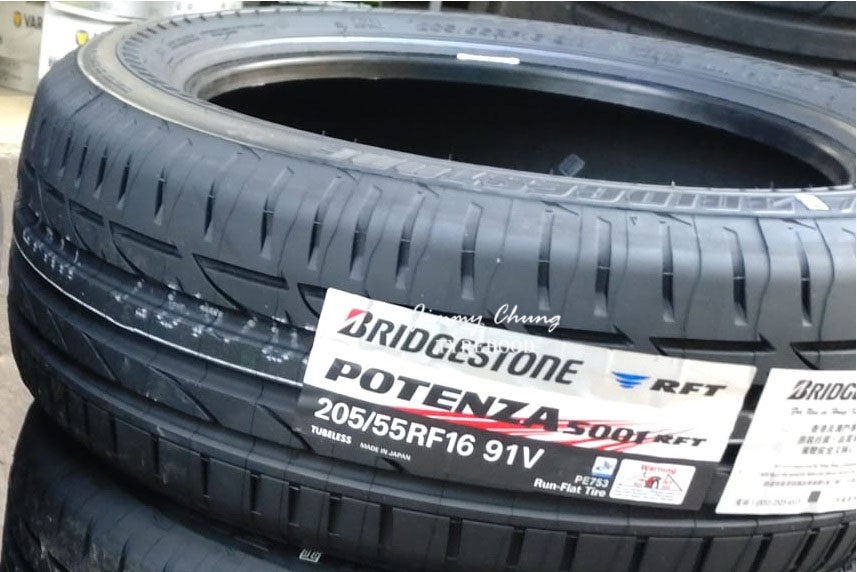
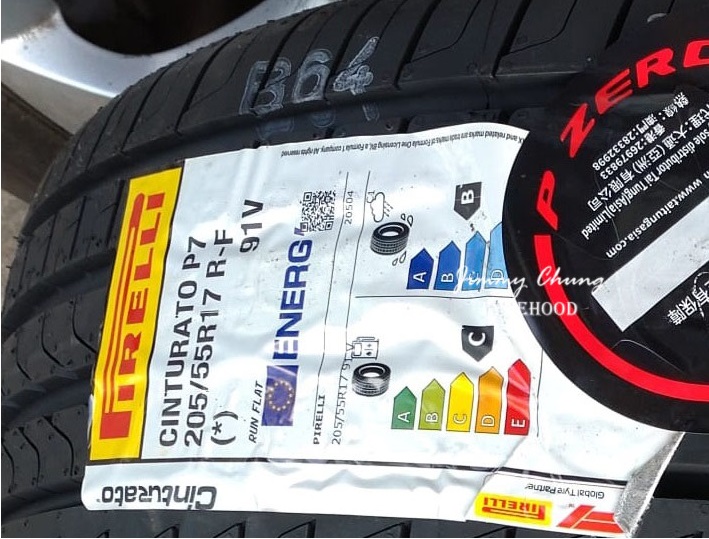
Another alternative is look for “Run flat” or “R-F” or “RF” around the tyre size. E.g. 205/55 RF16, or 205/55 R16 R-F, or 205/55 R16 Run Flat.
These wordings will appear on the tyre sidewall if it is a run-flat tyre.
AXA Travel, Home, Accidential Insurance offer promotion periodically as well as Zurich general insurance.
To purchase automotive tire, batteries and automobile, travel and personal insurance in HK, whatsapp Jimmy +852 5113 0668
Other related articles:
-> Understand more about self-seal tyre
-> Learn about 4 types of tyre in the market
-> Get the basic of tyre tread pattern – asymmetric, symmetric, directional
Other articles:
-> Tyre related information
-> Automotive Battery related information
-> Vehicle maintenance and DIY
-> Global Travel Guide
